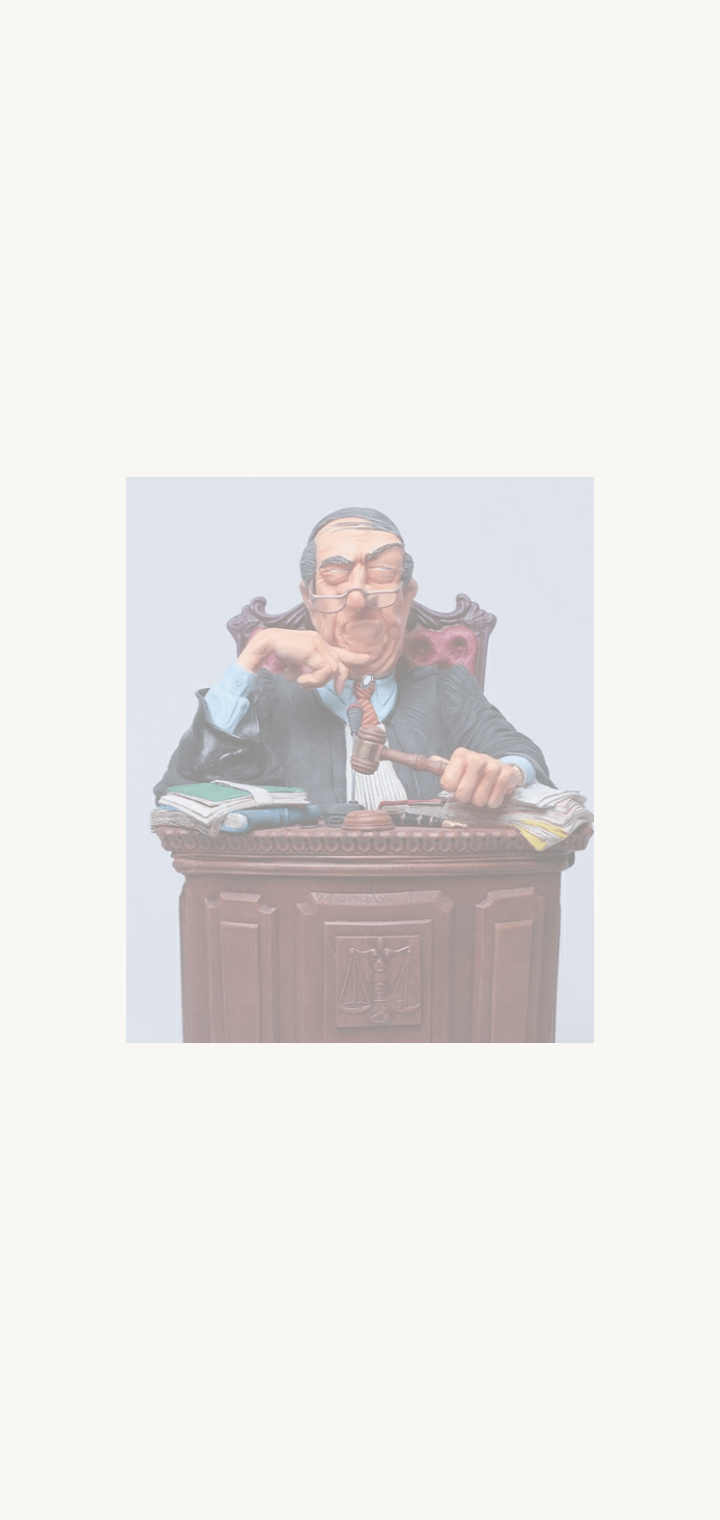
Is it a real bar (where people drink), where the Lawyers sit?🤔🙄😮😲

Bar..??##!!?? Bench..!!??##??

Is it a real bar (where people drink), where the Lawyers sit?🤔🙄😮😲

Do the Judges really sit on a bench..??

Here’s the answer..

If you have ever been to a Court room….then you must have noticed that it essentially has three visibly distinct sitting arrangements for the 1. Presiding officer, 2. Lawyers and 3. Suitors, audiences & interns.

The place where the judges sit is called Bench and the place where the Advocates sit is called the Bar. To be specific the ‘Bench‘ is that part of the court considered in its official capacity, while the Judges are sitting. Black’s Law dictionary defines ‘Bar‘ as the railing that separates the front area where the Judge, court personnel, Lawyers and witness conduct court business, from the back area which provides seats for observers.

Thus the term`Bench’ is associated with the judges and the term`Bar’ is associated with the Lawyers and has nothing to do with bars where people drink..!!

Wondering why such names ..the bar and the bench..??

Well they are said to originate from the English Courts. In the old English courts judges would sit on an actual bench….there originates the term ‘Bench’. The term ‘Bar’ is also said to come from the English court, they have a literal metal/ wooden bar in the Court room that separates the others from the court officials. You may approach the literal bar and address the court officials.
This bar or railing in the Court was where the Lawyers could appear before the court. They say if you are a Lawyer, you are admitted to the ‘Bar’. Practicing Lawyers were allowed through the railing. This is still found in modern courts. A literal bar/railing separates the public in the gallery from the Judge.

In the modern times Bar is simply a collective term for the Advocates who are licensed to practice in a given court or jurisdiction and Bench means all the Judges.

May be the sitting arrangements in a court room are seperate but the services provided by the Advocates and the Judges in the administration of justice are complementary. Rendering justice is their joint responsibility.

When we say Bar-Bench relation, we mean the cordial relation between the Judges and the Advocates.

Long live the Bar & Bench..!!
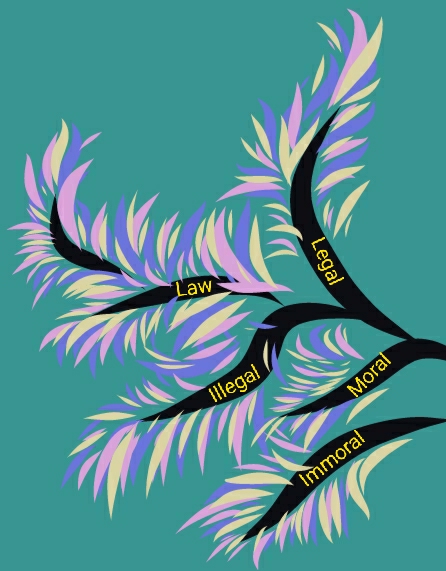
Being immoral is being illegal..??

Are you one of those who think that being immoral is being illegal..?

Then I must say that all this while you were simply wrong, because being moral and abiding by the law are not all the same. Just like an act could be moral but illegal similarly it could be immoral but perfectly legal…!!

Take an example, entry of refugees into a country is illegal while it is morally correct to provide food and shelter to them. Curses like slavery, paedophilia, child marriage though immoral were once accepted, but now they are universally held not only to be immoral but also illegal. The death penalty is considered immoral and illegal in many countries, but not in all. Smoking cigarettes and drinking alcohol are not only dangerous for health but also considered immoral in my country yet they are legal. Euthanasia is another issue where the morality clashes with law. There are many such examples.

To understand this better first let us know what is moral and what is law ?..

Morals are the principles of right and wrong and the goodness or badness of human character that may vary from person to person, religion to religion, country to country and so on. Morality governs personal interactions in the society. In other words morals are a set of beliefs, values and principles and behaviour standards which are enforced and created by society. They are surely not enforceable in the court of law, it is entirely the wish of an individual to follow it or not.

Law on the other hand is the system of rules that a particular country or community recognizes as regulating the actions of its citizens or members and may enforce such laws by the imposition of penalties. Law demands an absolute subjection to its rules and commands. Law has enforcing authority derived from the state. So there are many areas of conflicts between morality and legality. They are surely not the same.

There are different theories which deal with moral and law. Like according to John Stuart Mill the law should not be used to enforce moral principles on society but to protect harm to its citizens. Lord Devlin said that society may use the law to preserve morality in the same way that it uses the law to safeguard anything that is essential to its existence. Professor Hart’s theory is that the law should only intervene in the private lives of citizens to prevent harm to others and harm to oneself. He did acknowledge that there was a difficulty in defining harm but did acknowledge that it did not include moral harm to oneself. If you examine these theories we can infer that though in law morals have no special position but certainly law depends on moral principles at times. It is true that some laws mirror the majority of society’s moral view, for example, that murder is wrong and it is illegal too.

Perhaps we can say that morality is that which basically requires the people to honor the rights of others. Legal are those that do not violate the rights of others. So at this point only may be legality and morality intersect.

Thankfully all immoral acts are not illegal..! Otherwise imagine if every immoral act was illegal then even by telling a small lie we could end up in the jail..!!

GUILTY..NOT GUILTY….!!😮🤨🤔🙄

Judges are experts in dealing with laws and facts..they are wise as well..but after all they are human beings, as a matter of course they too are prone to misinterpretations, confusions etc. So what if a judge fails to make a decision..??

Is a deadlock situation possible while making a decision..??

Here’s the answer..

Practically this situation never arises..so a judge is always able to make a decision!! Law has every thing settled.

Where the court is unable to make up its mind due to equally favourable and unfavourable situation, there is existence of reasonable doubt. Which simply means that the evidence of the prosecution was not sufficient to sustain the guilt of accused beyond the point of moral certainty. In this situation Equipoise doctrine comes to its aid.

This rule states that when the evidence of the prosecution and the defence are so evenly balanced that the appreciation of such evidence calls for tilting of the scales in favour of the accused. Thus the evidence of the prosecution must be heavier to overcome the presumption of innocence of the accused.

The equipoise rule provides that where the evidence in a criminal case is evenly balanced, the constitutional, presumption of innocence tilts the scales in favor of the accused.⁠

The party that does not have the burden of proof has the favour in this situation.

Therefore in such a situation, according to the doctrine, in a civil proceeding the defendant must prevail and in a criminal proceeding where the court has a reasonable doubt the accused must prevail, as the plaintiff/prosecution has failed to fulfill its burden of proof. Remember that the right to be presumed innocent until proven guilty can be overthrown only by a proof beyond reasonable doubt. Absence of such proof is the basis of acquittal.

So judges may make bad decisions but they can never fail to make one…!!

Conclusion is: When the judge cannot make a decision the judgement is always “not guilty” 😜 .

Pic: mouldindia

CYBER CRIME : A global phenomenon.

What is CYBER CRIME ?

• The conduct is facilitated by information and communications technology;

• It is motivated by intent to commit harm against a person or an organization or a Government;

• The Intended harm encompasses conduct amounting to interference or damage to either tangible or intangible property owned by an individual or organization; and

• The conduct concerned is criminalized within either the jurisdiction of the victim or the jurisdiction of the accused.

Need for Cyber Laws

Rapid Growth of Information & communication Technologies globally

+

Evolution of new breed of Criminals i.e. CYBER CRIMINALS

+

Difficulty in applying traditional Laws

=

Need for enactment of Cyber Laws

Paper Laws for paperless Environment

•The 1st Computer specific law was enacted in the year 1970 by the German State of Hesse in the form of Data Protection Act.

•In 1990, England became the 1st European Country to enact a law and address computer crimes specifically as The Computer Misuse Act .

•In 2000, India also passed its Information Technology Act.

Global Efforts

• Budapest Convention (2001);

• United Nations Convention against Transnational Organized Crime (2000) and its three protocols;

• European Convention on Mutual Assistance in Criminal Matters (1959);

• Inter-American Convention on Mutual Assistance in Criminal Matters (1992);

• Stanford Draft International Convention to Enhance Protection from Cyber Crime and Terrorism (1999);

• Draft African Union Convention on the Establishment of a Credible Legal Framework for Cyber Security in Africa (2011); and

• Commonwealth Model Law on Computer and Computer Related Crime (2002).

Why Cyber Crime is Global?

•The information and communication technology is globally distributed. Large number of people are using ICTs across the globe.

•There are no cyber- border between countries. They are trans national.

•Easy accessibility to ICTs is another factor making Cyber crimes global.

•Cloud computing (portability and transferability of cloud between servers).

Increase in rate of Cyber Crimes

Trans-jurisdictional barriers

+

Subterfuge

+

Lack of public outcry / crime reporting

+

The inability of key stakeholders in criminal justice systems (investigators, prosecutors, judges ) to grasp fundamental aspects of technology aided crime

=

Negative impact on conviction rates.

=> Increased rate of cyber crimes.

How to Combat?

•Urgent need of international binding legal instrument such as a convention on cyber crime under the umbrellas of the United Nations.

•Introduction of uniform and thorough cyber crime reporting mechanisms.

•Constituting special task forces with members who are experts in cyber technology to investigate cases of cyber crime.

•Encouraging the development of technological safeguards for securing the cyber space.

•Cyber crime awareness raising campaigns.

Suggestions

•Creating legal categories of cyber crime offences by tailoring laws to meet changes in technology should be avoided.

•Laws should be made to cover technology broadly within recognized categories of criminal conduct for better effectiveness.

Cyber Crimes are Global, Real and Expanding phenomenon.

“Order ! Order”!

“Order! Order”! : The Judge and the Hammer..??##!!


A court-room full of audiences humming under suspicion, where the judge is about to pronounce its final decision under a catch-22 situation and bang! bang..! The judge bangs the hammer and shouts “Order! Order”!

We all are familiar with this court-room drama presented in various films and serials but have we ever given a thought as to why such a weird tradition of banging a hammer exists in a place like the court-room..??

So first of all in this case the hammer/mallet is a ceremonial one and is called a gavel which is made out of wood and is banged on a wooden block. It symbolizes the authority of the presiding officer. It represents the power of a judge to control.

Secondly the purpose behind such a tradition is to call the attention of those present in the court-room. It is beyond the dignity of the judge to yell or scream in order to keep the court room under control. So the smack of a gavel is used to maintain the decorum of the court proceedings.

Now you may be thinking that such a tradition must be of an English origin. It is said to be a very ancient tradition in common law though the origin of the term “gavel” is unknown, the conjecture is, it may be masonic. Gavels are not used in English courts. Gavels are very much a feature of the U.S courts.

Another question that may arise; does the gavel have any legal significance? What if a judge uses it improperly? As we know that gavel is a ceremonial feature of a court so even if used inappropriately it will have no legal significance.

Besides the beam balance the image of a gavel is also popularly used in depicting justice, court, law etc.

So now you know why the judge bangs the hammer..😃!!!

Design a site like this with WordPress.com
Get started